China Golden Week Survival Guide: How to Not Hate Your Trip (October 2026)
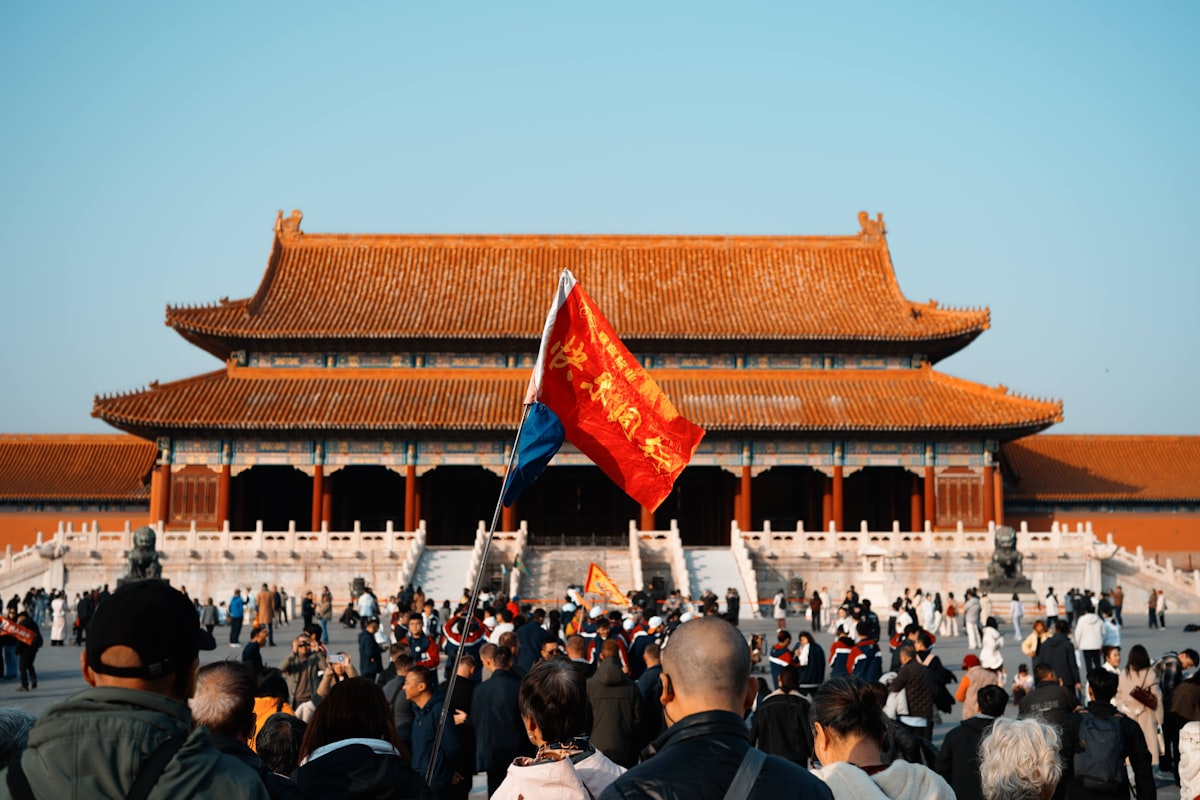
A friend of mine landed in Beijing on October 1 last year. She had a spreadsheet: Forbidden City Tuesday, Great Wall Wednesday, train to Xi’an Thursday. By 10am on day one, every single plan was dead.
The Forbidden City had sold out two weeks earlier. The train she wanted had been fully booked since the moment tickets opened. Her hotel, booked at ¥380, had quietly bumped to ¥980. The Great Wall at Badaling was, in her words, “not a wall but a conveyor belt of humans.” She spent her first three days in China problem-solving from a hotel room, refreshing ticket apps.
She still had a good trip eventually. But she lost three days to a holiday she didn’t know existed. This guide exists so you don’t lose those days.
What Golden Week actually is
Golden Week (国庆黄金周, Guóqìng Huángjīnzhōu) is the seven-day National Day holiday, October 1 through 7 every year. It celebrates the founding of the People’s Republic of China in 1949. If you have spent any time around Chinese travel content, you have probably heard it compared to Chinese New Year. That comparison is wrong in ways that matter.
Chinese New Year (Spring Festival) empties cities as everyone goes home to family. Shops close. Restaurants shutter. The country pauses. Golden Week does the opposite: everyone leaves home to travel, every shop runs sales, every restaurant is open, every attraction is at maximum capacity. Spring Festival is a family holiday that happens indoors. Golden Week is a national vacation that happens in public, at scale.
The numbers are staggering. In 2025, domestic tourist trips during Golden Week reached over 800 million. That is roughly the entire population of Europe traveling inside one country in one week. High-speed rail tickets for popular routes sell out within minutes of release. Hotel prices in major destinations double, triple, or in some cases quintuple. The queue for the Forbidden City’s Meridian Gate can stretch past an hour before you reach security.
This is not exaggeration for dramatic effect. It is what happens when 1.4 billion people get the same week off.
The honest truth: what Golden Week actually looks like
If you have never traveled during Golden Week, the scale is hard to picture. Here is what the week feels like on the ground.
Trains. High-speed rail tickets go on sale 15 days before departure. For popular routes, like Beijing to Shanghai or Chengdu to Xi’an, every seat vanishes in under 60 seconds. Not “the cheap seats” or “the good times.” Every seat, every class, every departure. If you do not book the moment the window opens, you are not taking that train. The alternative is standing tickets, which on a five-hour high-speed journey mean sitting on your suitcase in the gap between carriages alongside forty other people doing the same thing.
Attractions. The Forbidden City caps daily visitors at 80,000. It reaches that cap every single day of Golden Week, usually by mid-morning. The Great Wall at Badaling moves at the pace of the slowest person in the queue, which during Golden Week is everyone. The Bund in Shanghai on the evening of October 1 is not a promenade. It is a crush. West Lake in Hangzhou averages over 500,000 visitors per day during the holiday. You will not find a quiet corner. You will not find a corner at all.
Hotels. A room that costs ¥350 in September will go for ¥800 to ¥1,200 during Golden Week. If you booked early and got a reasonable rate, check your reservation. Hotels sometimes cancel third-party bookings to re-list at the holiday rate. It happens enough that you should have a backup.
Streets and subways. Major pedestrian streets like Nanjing Road in Shanghai or Wangfujing in Beijing become rivers of people. Subway cars on Lines 1, 2, and 10 in Beijing reach a density where you cannot raise your arm to check your phone. Didi wait times in city centers routinely exceed 30 minutes for a 15-minute trip.
None of this makes China a bad destination. It makes Golden Week a bad time to visit the obvious places. The entire survival strategy comes down to one principle: go where the 800 million other travelers are not going.
The survival strategy: if you must travel during Golden Week
Maybe your employer only approved these dates. Maybe you are meeting someone. Maybe you already booked the flights and cannot change them. Whatever the reason, you are locked into October 1-7. That does not mean your trip is doomed. It means you need a strategy.
Book trains the second tickets open
China releases train tickets 15 days before departure, at an announced time (usually 8am or 2pm Beijing time). You set an alarm. You have 12306 or Trip.com open and logged in. You have your passenger information pre-saved. You click “buy” the instant the clock rolls over. This is not advice. This is how Chinese travelers do it, and you are competing with them.
If you miss the window, check back 24 to 48 hours later. Cancellations happen, and some tickets get released in batches. Also check stations one or two stops before or after your target. A ticket to “Beijing South” may be gone, but “Tianjin” on the same line may still have seats, and Tianjin to Beijing is a 30-minute hop.
A better approach: avoid intercity trains altogether during Golden Week. Pick one city and stay there. You will see more of that city than anyone who spends half their trip in transit queues, and you will not spend October 3 staring at a “sold out” screen.
Visit attractions before 8am or after 4pm
Tour groups operate on a schedule. Buses arrive between 9am and 10am. The window from opening time (often 7:30am or 8am) until 9am is yours. It will not be empty, but it will be manageable. After 4pm, the tour buses begin leaving, and sites stay open until 5pm or 6pm. The last two hours are consistently the quietest of the day.
For the Forbidden City specifically: tickets are released online only, in batches, and sell out instantly. You need to be on the official WeChat mini-program the moment they drop. If you cannot get Forbidden City tickets, Jingshan Park directly north gives you the same imperial roofscape view from above, costs ¥2, and rarely sells out.
Avoid these specific places
Some destinations are genuinely not worth attempting during Golden Week. This is not snobbery. It is physics. Too many people in too small a space.
-
Great Wall at Badaling: The most accessible section is also the most crowded section. It is the default choice for every tour bus within 200 kilometers of Beijing. During Golden Week, the wall itself is a continuous line of people. Instead, go to Mutianyu (45 minutes further, same restored wall, half the density) or Jinshanling (2 hours from Beijing, unrestored sections, dramatically fewer visitors). Our Great Wall section comparison guide covers the trade-offs in detail.
-
The Bund, Shanghai at night: October 1 through 3, the Bund becomes a crowd-control operation. Police direct foot traffic in one direction. The riverfront fills to capacity. The view is spectacular, but so is the experience of being slowly herded by thousands of strangers. Go at sunrise instead. The skyline is still lit, the promenade is nearly empty, and you will actually see it.
-
West Lake, Hangzhou: During Golden Week, the lakeside path becomes single-file. The famous “Broken Bridge” has so many people on it that you cannot see the bridge. Hangzhou itself is wonderful, but West Lake during Golden Week is a test of endurance, not a scenic experience.
-
Forbidden City, Beijing: As mentioned, 80,000 tickets sell out daily. If you get one, you are in a crowd of 80,000. If you do not, the view from Jingshan Park is better anyway, and the National Museum across the street has equally impressive artifacts with slightly more manageable crowds.
Stay in one city
The multi-city hop is the most common first-timer mistake during Golden Week. Beijing to Xi’an to Chengdu to Shanghai looks efficient on a map. In reality, each transfer costs you a day of queueing, a night of hotel-hunting, and a growing sense that you are spending your vacation inside transportation infrastructure.
Pick one city. Explore it deeply. A traveler who spends seven days in Chengdu will visit the panda base, eat at 15 different restaurants, find a teahouse they love, take a day trip to Leshan, and leave feeling they know the place. A traveler who hits four cities in seven days will remember train stations and check-in desks.
The one-day-ahead rule
During Golden Week, spontaneity stops working. You need to buy attraction tickets, book restaurants, and plan routes at least one day ahead. Walk-up entry to major sites is a fantasy during this week. Download the site’s mini-program or use Trip.com to pre-book everything. If a ticket is available right now, buy it right now. It will not be available tomorrow.
Where Golden Week is actually enjoyable
This is the part most Golden Week guides miss. They tell you what to avoid. They do not tell you where to go. But China is enormous, and the 800 million trips are not evenly distributed. They concentrate on the same 20 destinations every year. Go somewhere else and Golden Week becomes a non-issue.
Smaller cities that stay quiet
While Beijing, Shanghai, and Xi’an are absorbing tens of millions of visitors, smaller Chinese cities experience almost no change. These places are not “lesser” destinations. They are simply not on the domestic tourist circuit.
-
Quanzhou (Fujian): A historic port city with Song Dynasty architecture, one of China’s best street food scenes, and a waterfront that rivals any coastal city. During Golden Week, Quanzhou is busy by local standards and empty compared to Xiamen two hours away. Maritime Museum, Kaiyuan Temple, and the old city streets are all open and walkable.
-
Chaozhou (Guangdong): Teochew cuisine, Gongfu tea culture, and the Guangji Bridge that dates to the Song Dynasty. The city is compact, walkable, and ignored by mass tourism. During Golden Week, you can eat at restaurants that in a larger city would require a two-hour wait.
-
Xiapu (Fujian): A fishing county with mudflats, seaweed farms, and some of the best coastal photography in China. October is the harvest season for kelp, and the light at dawn over the tidal flats draws photographers, not bus tours.
-
Datong (Shanxi): The Yungang Grottoes and the Hanging Temple draw visitors, but Datong is not on the Golden Week main stage the way Xi’an or Luoyang are. The city’s knife-cut noodles alone are worth the trip.
Rural and remote regions
Scale is your friend during Golden Week. The larger the area and the sparser the population, the less the holiday matters.
-
Xinjiang: Kanas Lake in October is autumn-color perfection. The drive from Urumqi to Kashgar crosses landscapes that make crowds geometrically impossible. Domestic tourism exists here, but Xinjiang is the size of Iran. The crowds spread thin.
-
Tibet: Permits already limit visitor numbers. During Golden Week, the permit system does not change, so Tibet does not get proportionally busier. Lhasa in October has clear skies and daytime temperatures around 15 degrees Celsius. The Barkhor Circuit is busy by Tibetan standards, which means it feels like a normal Tuesday in Chengdu.
-
Inner Mongolia grasslands: By October, the grasslands have turned gold, the summer tourists are gone, and the herds are moving to winter pasture. The Hulunbuir region is vast enough that you can drive for hours without seeing another vehicle.
-
Guizhou: The mountains, rice terraces, and Miao villages of Guizhou are spread across a province the size of Greece. The minority villages around Kaili and Congjiang see some domestic tourism, but at a fraction of Yunnan’s density. October temperatures are mild, and the rice terraces are in late harvest, which means golden colors and fewer people than the Longji terraces outside Guilin.
When city travel actually works
If you are set on a major city, there is a way to make it work: reverse tourism (逆向旅游, nìxiàng lǚyóu), a trend Chinese travelers themselves have embraced. The idea is simple: visit the city’s secondary attractions and neighborhood streets instead of the landmark checklist.
In Beijing, skip the Forbidden City and spend the day walking the hutongs south of Gulou. Visit the Temple of Earth instead of the Temple of Heaven; it is the same Ming Dynasty architecture without the tour buses. Eat at a neighborhood hot pot place in Dongsi rather than queueing for Quanjude roast duck. The city’s real texture lives in its streets and courtyards, not its ticket gates.
In Shanghai, skip the Bund and Nanjing Road. Walk the former French Concession in the morning, when plane trees shade empty streets. Visit the Propaganda Poster Art Centre, a private museum in a basement that most guidebooks miss. Eat soup dumplings at a neighborhood shop on Changle Road rather than the two-hour queue at Jia Jia Tang Bao.
In Chengdu, skip the Panda Base (or go at 7:30am opening, see exactly one panda before the crush, and leave). Instead, spend the afternoon at a teahouse in Renmin Park, where the real Chengdu happens: mahjong games, ear cleaning, and tea that costs ¥15 with unlimited hot water refills. The pandas are adorable. The teahouse is the city’s actual soul.
How to eat well during Golden Week
Restaurants in China do not close for Golden Week. Quite the opposite. It is one of the busiest dining weeks of the year, and most restaurants run extended hours. The problem is not availability. It is queues.
Popular restaurants, especially those featured on social media or in guidebooks, will have waits of 60 to 120 minutes at peak meal times. The solution is not to avoid eating. It is to eat at the wrong times.
Lunch at 11am or 2pm. Dinner at 5pm or 9pm. The peak lunch window is 12pm to 1pm, and the peak dinner window is 6pm to 8pm. Eating one hour outside these windows cuts your wait time from 90 minutes to maybe 15.
Also: eat where the locals eat, not where the tourists queue. A restaurant with a line of people holding selfie sticks is not a restaurant you want to be in. Walk two blocks perpendicular to the main street. Find a place with plastic stools, a handwritten menu, and zero English. The food will be better, the price will be lower, and you will sit down immediately.
Street food markets during Golden Week are an exception to the “go off the main street” rule. Night markets in cities like Xi’an, Chengdu, and Changsha are part of the holiday experience. They will be packed. That is the point. Go for the atmosphere, eat whatever looks good, and accept that the Muslim Quarter in Xi’an during Golden Week is a contact sport.
What is open and what is closed
This section matters because the rules are different from what a Western traveler might expect.
Government services: Closed for all seven days. This includes visa offices, police stations for registration purposes, and most administrative buildings. If you need a visa extension or a residence permit stamp during Golden Week, you are waiting until October 8. Plan accordingly.
Banks: Main branches in city centers may stay open with reduced hours. Smaller branches close. ATMs work normally, and mobile payment makes this largely irrelevant for most travelers.
Shops and malls: Open, often with extended hours and Golden Week sales. Chinese retail treats Golden Week the way American retail treats Black Friday. Expect discounts, promotions, and crowds at shopping centers. If you want to buy electronics, clothes, or souvenirs, Golden Week is actually a good time for prices.
Restaurants: Open, busy, and worth planning around (see above).
Museums and attractions: Open. Many extend their hours during Golden Week. The problem is not closure. It is tickets.
Tourist sites: Open. Probably the busiest week of the year.
Public transport: Subways and buses run on holiday schedules, which means slightly reduced frequency on some lines but still fully operational. In major cities, subways may extend their last-train time by 30 to 60 minutes to accommodate holiday crowds.
The short version: for a traveler doing tourist things, Golden Week does not close anything you care about. It just fills it to capacity.
October weather: what to expect by region
October is one of the best weather months in China. Temperatures are moderate, rainfall drops off in most regions, and the oppressive summer humidity has broken. If Golden Week crowds were not a factor, October would be the ideal month to travel in most of China.
Northern China (Beijing, Xi’an, Datong, Harbin): Daytime highs of 18 to 22 degrees Celsius, dropping to 5 to 10 degrees at night. Dry, sunny, and crisp. The leaves in Beijing start turning in mid-October. A light jacket for mornings and evenings is enough. No rain to speak of.
Eastern China (Shanghai, Hangzhou, Nanjing, Suzhou): Daytime highs of 22 to 25 degrees, nighttime lows of 14 to 17 degrees. Humidity drops noticeably compared to September. October is the best month for walking cities in this region. Occasional typhoon remnants can bring rain, but it is rare by early October.
Southern China (Guangzhou, Shenzhen, Guilin, Hong Kong): Still warm at 28 to 32 degrees during the day, 20 to 22 degrees at night. Humidity is moderate. Rain is less frequent than in summer months. Guilin and Yangshuo are in peak season for good reason: the karst scenery under October skies is as good as it gets.
Western China (Chengdu, Chongqing, Kunming, Lijiang): Chengdu and Chongqing sit at 18 to 22 degrees with overcast skies, as always. Kunming at 1,900 meters elevation stays at 15 to 22 degrees with sun. Lijiang is cooler at 10 to 18 degrees. Western Sichuan and northern Yunnan are in peak autumn color season. The elevation means you need layers, but the weather is consistently good.
Northwest China (Xinjiang, Gansu, Qinghai): This is the magic window for northwest China. Kanas Lake in Xinjiang peaks in autumn color during the first two weeks of October. Daytime temperatures at 10 to 18 degrees, dropping to near freezing at night. The tourist season ends after Golden Week, so the window is narrow, but the scenery is worth the timing. The grasslands have turned gold, the poplar forests are electric yellow, and the light has that autumn clarity that makes every photo look better than it should.
Tibet and the plateau: Daytime 12 to 18 degrees, nighttime dropping below freezing. Dry, sunny, and intensely clear. The summer monsoon is finished and the winter cold has not yet arrived. October is arguably the best month for Tibet, with the clearest mountain views of the year. The altitude does the same thing it always does; the weather is just more cooperative in October.
The alternative: go the week after
If you have flexibility, the single best piece of advice in this guide is: visit China October 8 through 20 instead of October 1 through 7.
The weather is identical. The autumn colors are the same or better. Hotel prices drop back to normal on October 8. Attractions empty out. Trains have seats. Restaurants have tables. You get the same country in the same season with none of the structural chaos.
The first week of October is a compressed nightmare because the entire country is on vacation simultaneously. On October 8, the country goes back to work, and every tourist site in China suddenly becomes visitable again. If your dates are flexible at all, shift your trip by seven days. You will see more, spend less, and enjoy all of it.
Summary: the Golden Week decision
You have three options for traveling in China around National Day. Each is valid. Each has trade-offs.
| Strategy | What it looks like | Who it works for |
|---|---|---|
| Avoid entirely | Travel October 8-20 instead of October 1-7 | Anyone with flexible dates |
| Embrace with strategy | One city, early mornings, off-peak attractions, advance bookings | Travelers locked into these dates who can commit to planning |
| Go remote | Xinjiang, Tibet, Inner Mongolia, Guizhou countryside | Travelers who want to travel during Golden Week without the crowds |
The only bad strategy is the default one: a multi-city tour of China’s most popular attractions during Golden Week with no advance bookings. That is not a vacation. That is an expensive lesson in crowd dynamics.
If you do one thing after reading this guide: check whether your trip overlaps October 1-7. If it does, pick one of the three strategies above and commit to it. Half-measures during Golden Week do not work. Either avoid the crowds, plan around them, or go somewhere they are not.
Related guides
- First-Time China Travel Guide — everything you need before your first trip
- China Holiday Calendar 2026 — the full year of Chinese holidays, which to avoid and which to plan for
- China High-Speed Rail Guide — how to book, board, and ride trains like a pro
- Mid-Autumn Festival 2026 Guide — the festival that comes right before Golden Week; mooncakes, lanterns, and September travel